
Despite growing pedagogical interest in extended reality, a critical knowledge gap remains regarding how disabled people can navigate XR environments to achieve equitable learning outcomes. While many educators have expressed interest in incorporating XR into their curricula, they routinely express concerns regarding accessibility barriers of this technology. This mismatch between growing educational demand for XR technology and the limited understanding surrounding disabled students’ needs presents an ethical imperative to explore their firsthand experiences.
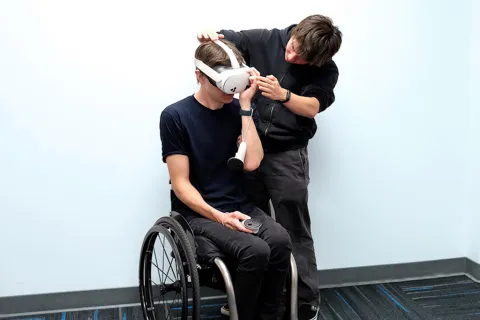
“Promoting Instructional Equity: Exploring the Experiences and Needs of Disabled People Navigating XR Digital Learning Environments” is a UCLA research project examining how students with disabilities experience extended reality (XR) technologies, including virtual reality (VR) and augmented reality (AR), in educational settings. The project responds to a growing need for evidence-based guidance on how immersive technologies can be used in ways that are accessible, inclusive, and equitable for students with diverse physical and sensory abilities.
The study brings student participants into UCLA’s OARC Immersive Futures Lab to complete a series of educational activities using virtual and extended reality (VR/XR) technologies. During these sessions, students interact with XR learning modules, complete surveys, and participate in interviews about their experiences.
The research team records the sessions and participants’ interactions with the XR environment to study how students navigate immersive learning activities and where accessibility barriers arise. Students with physical disabilities will be compared with a non-disabled student group to identify which challenges are specific to accessibility and which reflect broader issues with XR interfaces or instructional design. The study also includes interviews with educators to understand how XR is being incorporated into teaching.
Ultimately, the project aims to turn these findings into practical resources for making XR-based education more accessible. Participant experiences will inform recommendations for instructors and disability service offices, establish best practices, identify inclusive tools, and overcome educational barriers for students with disabilities.
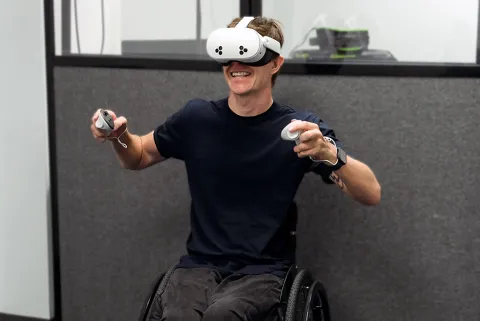
What to Expect as a Participant
If you are selected to participate, you will schedule sessions at the OARC Immersive Futures Lab on campus, where you will experience virtual and extended reality (VR/XR) technologies to complete educational activities and assignments. During each session, you will experience the VR/XR learning module, complete surveys, and describe your experiences to the researchers.
Participation involves 5 to 10 sessions over the academic quarter, with each session lasting approximately 1 to 2 hours and a maximum total commitment of 20 hours. Participants will be compensated with gift cards, based on completed study modules. For total compensation of $500 value in gift cards, participants should expect to complete all modules and an exit interview.
Undergraduate, graduate and professional students with or without physical disabilities may be eligible.
Research Team
Principal Investigators
- Travis Lee, Manager, Disabilities & Computing Program | Office of Advanced Research Computing
- Francesca Albrezzi, PhD, Manager and Digital Research Specialist, GIS and Visualization | Office of Advanced Research Computing
- Carolanne Link, Senior Program Manager, Disabilities & Computing | Office of Advanced Research Computing
Harold Pimentel, Ph.D. Assistant Professor | Department of Computational Medicine | Department of Human Genetics | David Geffen School of Medicine at UCLA
Joy Guey, Emerging Technologies Advocate and Director of Bridge Innovation Studio | BruinTech
Lab Manager
Student Assistants
Grayson Nurnberg
Harry Lowy